

Q&A with Hella Bel Hadj Amor, Pilot Cohort SDP Fellow Alumna
This Q&A is part of an SDP Blog series profiling members of the 2023 – 2025 SDP Alumni Advisory Board. All posts from this series may be found here.
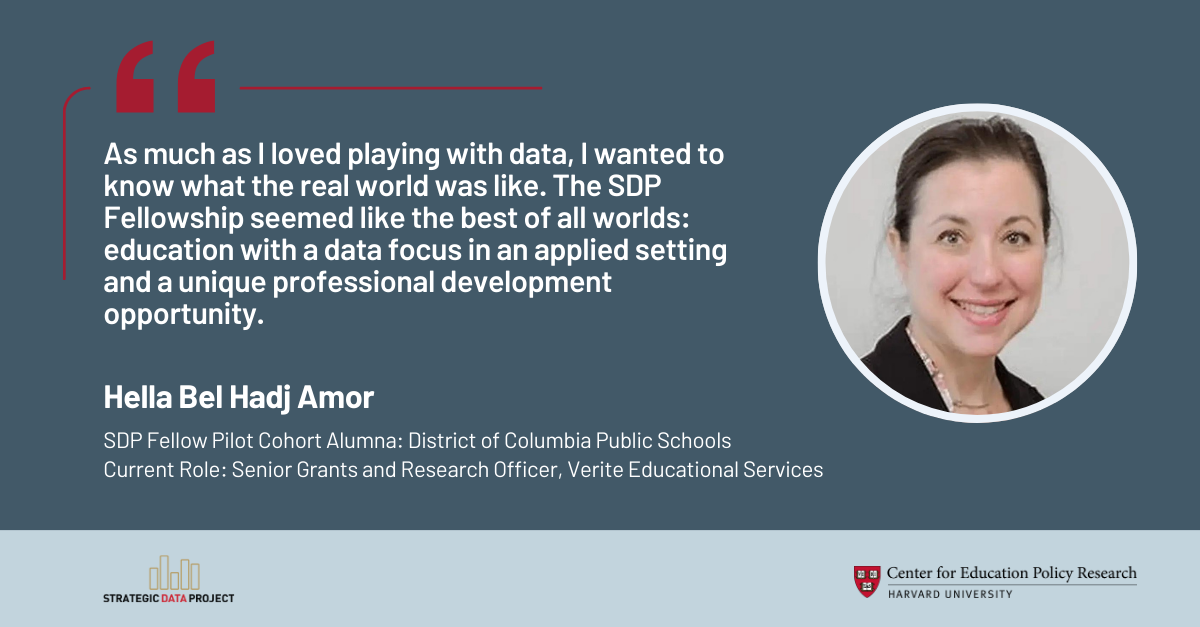
Hella Bel Hadj Amor is an alumna of the Strategic Data Project (SDP) Fellowship’s pilot cohort (2008-2010), where she was an SDP Fellow with the District of Columbia Public Schools (DCPS). As an SDP Fellow, Hella led the district’s initiative for valued-added measures in teacher evaluation. Today, Hella is the Senior Grants and Research Officer at Verite Educational Services, an education and technology consulting company. Prior to her current role, Hella worked at the American Institutes for Research and Education Northwest. Hella has a wealth of experience as a program evaluator, technical assistance provider, and education researcher, specializing in the educator pipeline, college and career readiness, career and technical education, out-of-school time programs, and school leadership. Hella holds an M.A. in Economics and a Ph.D. in Public Administration from New York University.
What drew you to the SDP Fellowship?
I was an economist with a background in math and an interest in international development, so I decided to get a Ph.D. in economics. I hated it. It was all theory, and I had gotten away from math because of that. I switched to public administration because it seemed more applied, and there was a professor who was an economist focused on education and looking for a research assistant. I started working on her education projects and I was hooked. Later, I became a researcher in a university research center. I started looking for another job because, as much as I loved playing with data, I wanted to know what the real world was like. The SDP Fellowship seemed like the best of all worlds: education with a data focus in an applied setting and a unique professional development opportunity.
What is the most memorable or impactful moment or experience from your time as an SDP Fellow?
DCPS moved fast to reform educator evaluations under the waiver and wanted to use measures of student growth as part of the new system. As a fellow, that was one of my charges. When I started, several people said to me, "You're going to fail," or "Even if you can do it, you won't be able to do it on their crazy timeline." Well, I did it, with incredible support from SDP and CEPR (special shout-out to my faculty advisor, Eric Taylor), and when I did accomplish it, the Director of Human Capital wrote me a poem of gratitude and celebration!
Tell us about your current job!
I am a program evaluator, grant writer, technical assistance provider, business developer, and strategic planner. Daily, I read and write emails to make sure my clients and colleagues have what they need from me and that I don't miss an important new happening or resource in the field. I check my project plans to stay on top of deadlines and deliverables. I do some work individually and some collaboratively, in meetings or through shared tools. I think about new people to connect with and old ones to reconnect with to find good work to do together. The typical day that isn’t really typical: I meet with colleagues to review the most recent requests for proposals we may want to respond to, I sketch an evaluation design, I run a focus group, I analyze data, I write a piece of a grant for my organization or for a partner, I create a budget, I work with my reference desk librarian to identify evidence-based practices to include in my next report, I create a deck for a training, I meet with a potential client to identify a scope of work, I reach out to an independent consultant who can contribute to that scope of work, I skim an article on a topic of interest, I respond to an urgent request, I talk through an issue with a colleague, I have a webinar in the background while I copy-edit a colleague's work... it can be a long day. The most rewarding aspect of my role is the variety, different kinds of tasks, content areas, individual and teamwork, and learning throughout.
What skills did you gain from your time as an SDP Fellow that you find helpful in your current role?
Although I don't regularly do much fancy quantitative work anymore, I still know enough to have an intelligent conversation about it, which is useful because I need to be able to do that with some clients and with my quantitative collaborators. Working as an SDP Fellow in a school district (and coming from academia), I learned to work fast, be flexible, and to navigate bureaucracy, legalese, and politics.
What changes do you anticipate in your field in the next year?
More AI use. More crises as K-12 budgets are cut, and much-needed staff are let go. (Hopefully strategic) talk on decreasing interest in college. Science of Math.
What advice would you give to current or prospective SDP Fellows?
The SDP network is an invaluable resource. Whatever you need—an article, code, a recommendation; a thought partner, a collaborator; someone to share what they're doing, what they've accomplished, what they've learned—is an email or Slack message away. As the network grows, so does the range of experiences and settings you can call on. The generosity is overwhelming and the learning is immense. And it's an incredibly fun group.
What is something that you would tell your younger self about your career?
You have no idea where you'll land, professionally and geographically, the breadth of people you'll meet, what you will accomplish, and what you will overcome.
When you were a kid, what did you want to be when you grew up?
I wanted to work with dolphins!
What is something you enjoy in your free time?
Volunteering in theaters. I get to see a lot of all kinds of shows and to serve and feel part of my community.