

Data-Driven Insights to Enhance Student Behavioral Health Monitoring
This Q&A is part of an SDP Blog series profiling members of the SDP Fellowship Cohort 15. All posts from this series may be found here.
Q&A with Meghan Scrimgeour & Colleen Paeplow at Wake County Public Schools, a Cohort 15 SDP Fellowship Partner Agency
Meghan Scrimgeour is a Cohort 15 (2023-2025) SDP Fellow and a Senior Research Analyst for the Wake County Public School System (WCPSS), the largest public school district in the state of North Carolina, serving 159,000+ students across 190+ schools. We recently caught up with Meghan and her supervisor Colleen Paeplow, a Cohort 3 SDP Fellow alumna and the WCPSS Senior Director of Program Accountability, to learn more about their exciting and impactful work.
Meghan, can you tell us about your role at WCPSS?
Meghan: I have the pleasure of being part of the Program Accountability Team within the WCPSS Data, Research, and Accountability (DRA) Department. The overarching aim of my team is to support a data-driven culture to expand equitable instructional and operational practices within the district. Working towards this goal, my primary responsibilities fall within four categories of staff support. The first category, conducting program evaluations, is a three-year process during which I evaluate the effectiveness of programs implemented within our schools that are designed to improve outcomes for staff and/or students. For the second category, building staff capacity, I collaborate with district decision makers to build their capacity to progress monitor programs they are implementing, and help them determine if their hard work is paying off such that their programs are creating the type of change they hope to see. For the third category, providing ad hoc support, I assist departments across WCPSS to create planning tools (e.g., logic models and monitoring plans), fulfill data requests, and conduct analyses on an ad hoc basis. Finally, for the fourth category, sharing resources with the intention of reaching all district staff, I work with my teammates to design and provide online resources such as professional learning courses, one-pagers on an array of research and program evaluation topics, and even a podcast. I enjoy that no day in my position is the same and that I get to pull from, and expand on, my toolkit of skills.
What excites you most about your job?
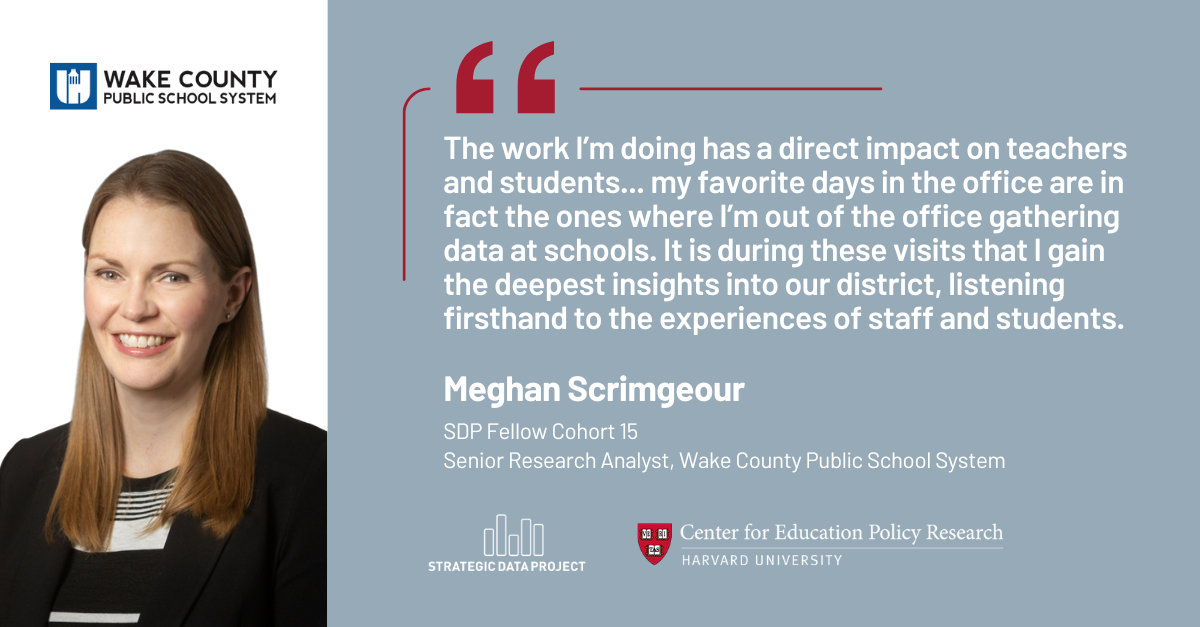
Meghan: There are several aspects of my position that excite me, but what stands out most is that the work I’m doing has a direct impact on teachers and students. It’s incredibly rewarding to feel like I’m making a difference in the lives of our staff and students. My favorite days in the office are in fact the ones where I’m out of the office gathering data at schools. It is during these visits that I gain the deepest insights into our district, listening firsthand to the experiences of staff and students. These conversations serve as a powerful reminder of why I do this work and the people I am ultimately working to support. My niece attends one of our elementary schools and I enjoy telling her that I work not just for her school, but for all the schools in the district. She gets a kick out of hearing that she and her classmates are my bosses.
Tell us more about your capstone project.
Meghan: WCPSS students need support in developing and maintaining their positive social, emotional, behavioral, and mental health. To address this area of need, the district has prioritized student well-being in its 2023-28 strategic plan. Guided by the Multi-Tiered System of Support (MTSS) framework, the district provides universal instruction and support at Tier I to all students. The Behavior Intervention Monitoring Assessment System (BIMAS) is a universal screener to help identify students who are at risk of future emotional or behavioral difficulties. Beginning in the spring of 2019, the district began rolling out the BIMAS screener to schools with the goal of all schools implementing it by fall 2026. Classroom teachers are charged with completing the teacher screener two times a year during the fall and spring screening windows. While the district has access to school- and teacher-level completion data as well as student-level data, we don’t have data that speak to how or if teachers are using the data to inform their instructional practices for identified students. As part of my capstone project, I will provide insights into the student-level BIMAS data, assess how schools are using the data, and develop recommendations for how central services can best support schools’ implementation and use of the BIMAS data to inform classroom instruction.
What impact do you hope to see as a result of the capstone project when it is completed?
Meghan: As a result of my capstone project, I hope to make an impact in two areas. First, by conducting an exploration of the BIMAS data, I will offer central services and school staff insights into the data so they are well-equipped to interpret and use the data to make data-informed decisions. Second, by assessing how or if schools are using the BIMAS data to support students’ well-being, I plan to provide guidance into what support schools need to implement the screener to fidelity, understand the results, and use the data to inform their classroom instruction with students who are at risk of emotional and behavioral difficulties.
Colleen: The long-term impact of this initiative is expected to include a significant strengthening of the behavioral data specific to the BIMAS screener. By leveraging this project, we aim to reignite district support for the systematic use of behavioral data to enhance student learning experiences aligned with Wake County Public School System’s Strategic Priority 2. This effort will facilitate a deeper understanding of how to effectively monitor and assess the implementation and use of the BIMAS assessment tool, ensuring its ongoing refinement and alignment with educational goals. Ultimately, the project will contribute to more informed decision-making and improved support for students, fostering a positive and data-driven learning environment.
What has been the most impactful experience from your participation in the SDP Fellowship so far?
Meghan: Choosing just one impactful experience from my time as an SDP Fellow so far is challenging, but the network of leaders I’ve had the chance to meet, collaborate with, and learn from has been invaluable. I’ve enjoyed learning from my cohort (they’re an incredibly impressive group!) and professionals in the field through workshops, convenings, summer statistics courses, working groups, affinity groups, and guidance from expert advisors. I’m grateful for this opportunity to connect with others and build relationships that foster my professional growth.
How has the SDP Fellowship strengthened the analytic capacity of your agency?
Colleen: The SDP Fellowship has brought significant value and enhanced analytic capacity to WCPSS by identifying incomplete and incorrect reporting within the BIMAS system. Through effective collaboration with both internal and external partners, Meghan, our Nominated Fellow, plays a pivotal role in developing solutions to address these issues that will ultimately result in increased accuracy and reliability of data reporting. This contribution strengthens the district's ability to make informed, data-driven decisions, supporting ongoing improvements in operational efficiency and the validity of the BIMAS data as the primary measure of social-emotional outcomes.