

The Middle-to-High School Transition: Insights from a Mixed Methods Approach
This Q&A is part of an SDP Blog series profiling members of the SDP Fellowship Cohort 15. All posts from this series may be found here.
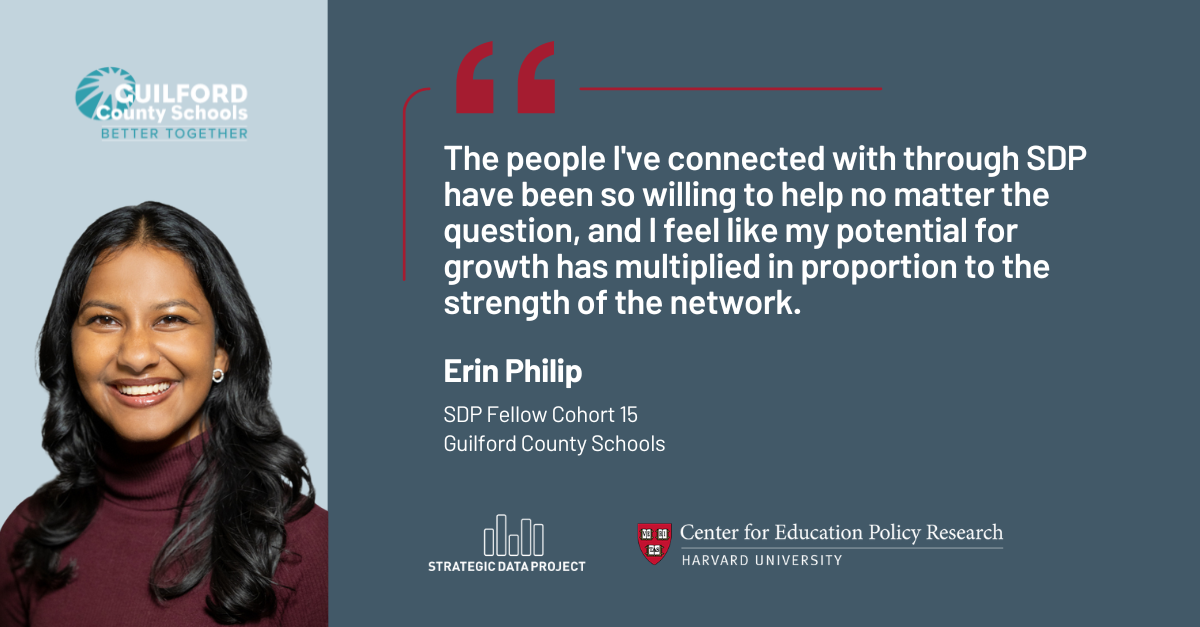
Q&A with Erin Philip & Sonya T. Stephens at Guilford County Schools, a Cohort 15 SDP Fellowship Partner Agency
Erin Philip is a Cohort 15 (2023-2025) SDP Fellow at Guilford County Schools, the third largest school district in the state of North Carolina, serving Greensboro and High Point. We recently caught up with Erin and her supervisor Sonya T. Stephens, a Cohort 3 SDP Fellow alumna and the Guilford County Schools Chief of Staff, to learn more about their exciting and impactful work.
Erin, can you tell us about your role at Guilford County Schools?
Erin: True to my job title as a Strategic Data Project Fellow, my role involves equal parts strategy and data. My role involves conducting qualitative and quantitative research to improve the middle-to-high school transition, building capacity for implementation and progress monitoring of strategic initiatives, and supporting district leaders through the development of the big picture strategic direction. I like that I get to wear many hats— on any given day, I might be conducting a literature review, coding interviews, or developing content and facilitating meetings for district leadership.
What excites you the most about your job?
Erin: Generally, I enjoy the opportunity to think about high-level strategy while also grasping the details using data. As a child of immigrants, I've also seen firsthand how education can drastically change opportunities within the span of a few generations. I am very grateful to have a job at the intersection of what I love to do and what the world needs (equitable opportunities in education)!
Tell us more about your capstone project.
Erin: National research shows that ninth grade is a make-or-break year. The transition from middle to high school can be characterized by increased rates of course failure, chronic absence, and behavioral issues. My capstone project is about helping schools employ effective practices to support the ninth-grade transition. I used interview and observation data to understand what current transition practices look like across schools. I am also conducting a quantitative analysis to understand the effectiveness of the freshman academy model, which is a self-contained learning community specially designed for ninth graders. One of the deliverables of my project has been a "Ninth Grade Transition Practice Library," which summarizes trends and novel practices across high schools in the district and highlights best practices for supporting students holistically through this transition period. Using the Ninth Grade Transition Practice Library as a starting point, the district is aiming to create a comprehensive transition plan that can be guaranteed for rising ninth graders, regardless of which high school they attend.
What impact do you hope to see as a result of the capstone project when it is completed?
Erin: I'd love to see this research help connect the dots in forming a comprehensive transition plan by identifying practices that should be implemented across all high schools, as well as corresponding central office supports. A best-case outcome would be that, with support from the district, high schools test out implementing some of the effective practices elevated through the research, and we can see the impact through ninth grade student success.
Sonya: Erin's work on ninth grade transition practices has provided our district with a solid foundation for preparing staff to support students as they move from eighth to ninth grade. This work identified key areas for improvement, including the need to provide equitable resources for students and to enhance professional development opportunities for staff. By focusing on a more cohesive and informed approach to teaching, these efforts aim to drive systemic improvements in educational outcomes across our 15 comprehensive high schools. As a result of this work, students transitioning to ninth grade will benefit from consistent practices that are identified and regularly monitored by district leadership, ensuring students have similar and equitable experiences during this critical transition.
What has been the most meaningful experience from your participation in the SDP Fellowship so far?
Erin: The access to data and education research all-stars that I've gained as an SDP Fellow has been invaluable, even just a year into the fellowship. For example, during the SDP Orientation in Fall 2023, we had a session on Root Cause Analysis, which I thought might be applicable for my project. I was able to connect with the session speaker, who connected me with experts from his network, to learn more about how to apply this protocol to my own context. For a different project, I've connected with alumni to explore using generative AI for qualitative analysis. My SDP Expert Advisor consistently pushes my thinking for conducting a rigorous, meaningful, policy-relevant analysis on my capstone. The people I've connected with through SDP have been so willing to help no matter the question, and I feel like my potential for growth has multiplied in proportion to the strength of the network.
How has the SDP Fellowship strengthened the analytic capacity of your agency?
Sonya: As an SDP Fellow, Erin has been an invaluable member of our leadership team. Beyond her work on ninth grade transitions, she has been deeply involved with the implementation of the district's strategic initiatives and, during that process, developed an evidence-based rubric that the leadership team has used to guide the prioritization of initiatives using an equitable process. Additionally, Erin has also been instrumental in our efforts to ensure we build the capacity of district leaders and their understanding of logic models and progress monitoring plans for each strategic initiative. Long term, this process will ultimately help the district to determine the return on investment as we continue to evaluate the work we are doing to improve student achievement at scale.