

Using a Data-Driven Approach to Guide District Leadership Toward Student Success
This Q&A is part of an SDP Blog series profiling members of the SDP Fellowship Cohort 15. All posts from this series may be found here.
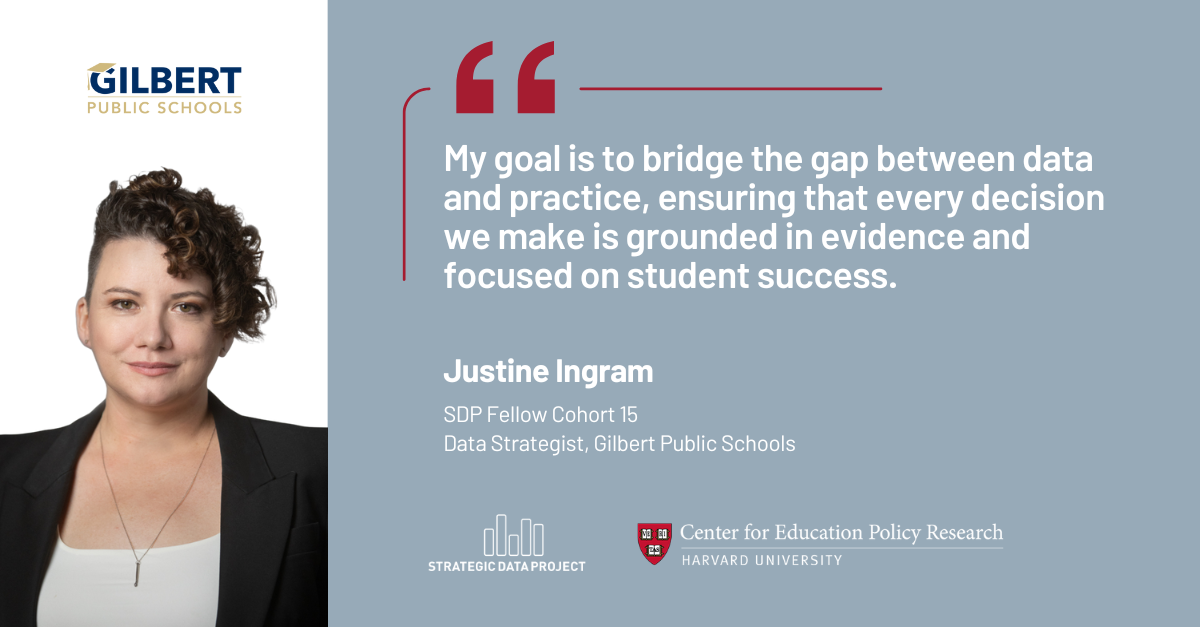
Q&A with Justine Ingram & Dr. Krista Cox at Gilbert Public Schools, a Cohort 15 SDP Fellowship Partner Agency.
Justine Ingram is a Cohort 15 (2023-2025) SDP Fellow and Data Strategist at Gilbert Public Schools in Arizona, a school district serving 30,000+ students in the Phoenix metropolitan area. We recently caught up with Justine and her supervisor, Dr. Krista Cox, the district’s Director of Curriculum, Instruction, and Assessment, to learn more about their exciting and impactful work.
Justine, can you tell us about your role at Gilbert Public Schools?
Justine: As a Data Strategist, I empower educational leaders to make data-driven decisions that improve student outcomes. I collaborate with school and district administrators to translate complex datasets into actionable insights, fostering a data-informed culture. This involves developing visualizations and reports, conducting predictive analyses, and providing training on data literacy and interpretation. My goal is to bridge the gap between data and practice, ensuring that every decision we make is grounded in evidence and focused on student success.
What excites you most about your job?
Justine: Having been a part of the Gilbert Public Schools community for 15 years, both as an employee and a parent, I'm incredibly passionate about contributing to the success of our students. I'm energized by our team's impact in such a short time, particularly in developing innovative data tools and fostering a data-driven culture. The opportunity to engage in educational research, collaborate with colleagues, and continuously expand my skillset in a field I care deeply about is truly motivating.
Tell us more about your capstone project.
Justine: My capstone project tackles the need to optimize support for our expanding English Language Learner (ELL) population. I'm conducting a comprehensive program evaluation to determine the most effective models of ELL instruction, staffing, and scheduling across different grade levels. By analyzing student performance data and considering various scheduling models, I aim to identify best practices and develop a data-driven framework for a program model. This project will provide valuable guidance to district and school leaders on which models are effective, ensuring that our ELL students receive the support they need to thrive academically.
What impact do you hope to see as a result of the capstone project when it is completed?
Justine: I envision this project having a multi-faceted impact. First, it will equip district leadership with a deeper understanding of program effectiveness and efficiency, enabling them to make informed decisions about resource allocation and program implementation. Second, it will establish a process for future program evaluations within the district, promoting a culture of continuous improvement. Finally, and most importantly, it will provide district and school leaders with research-based best practices to enhance ELL student outcomes, ensuring all students succeed.
Krista: Justine’s capstone project promises significant long-term impacts and benefits for our district. The project's emphasis on evidence-based decision-making will contribute to a culture of continuous improvement and the creation of a replicable evaluation process ensures that future programs can be assessed effectively, sustaining long-term benefits beyond the scope of this project. Moreover, this initiative introduces innovative approaches by integrating predictive analytics with practical strategies, bridging the gap between data insights and actionable change. The insights derived from this project are expected to drive smarter resource allocation and more effective program implementation, ultimately benefiting not only ELL students but the broader educational system as well.
What has been the most meaningful experience from your participation in the SDP Fellowship so far?
Justine: The SDP Fellowship has truly been a transformative experience, and picking just one impactful moment is hard. The workshops and trainings are insightful and have already made a difference in my work. But honestly, one of the best parts has been connecting with the other SDP Fellows. Hearing about their incredible work and learning from their diverse perspectives has been amazing. Working with my advisor has been incredibly impactful. The benefit of having thought partners who are experts in the areas related to my project and who are also supportive cannot be overstated. This whole experience has been such a catalyst for growth, both professionally and personally, and I'm extremely grateful for the opportunity.
How has the SDP Fellowship strengthened the analytic capacity of your agency?
Krista: Partnering with the SDP Fellowship has significantly enhanced our agency's analytic capacity and strategic decision-making. By bringing expertise in data analysis, visualization, and predictive modeling, Justine has helped transform how we leverage data to drive improvements in student outcomes. Her ability to translate complex datasets into actionable insights has empowered leaders across the district to make more informed, evidence-based decisions. Over the course of this project, we have created a new Data and Research department.
Justine’s work has also contributed to cultivating a data-driven culture within our organization, ensuring that decisions are not only grounded in evidence but also focused on equity and effectiveness. By providing tailored training on data literacy and interpretation, our Data and Research department has strengthened the capacity of administrators and staff to engage meaningfully with data.
Justine’s capstone project, focused on evaluating and optimizing support for our ELL population, exemplifies the value they bring. This project provides a clear framework for assessing program effectiveness, offering innovative solutions that address critical challenges. Ultimately, her contributions are shaping a more strategic, informed, and impactful approach to education within our agency.